
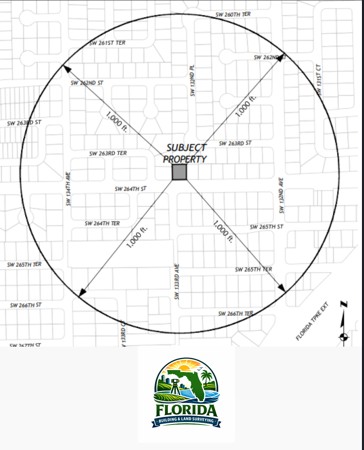
If you’re planning to open a business in Miami, one of the most overlooked—but critical—requirements is a radial distance survey. Across the City of Miami and throughout Miami-Dade County, zoning regulations require certain businesses to verify their distance from similar or regulated uses before permits are approved.
Search terms like “radial distance survey Miami,” “ALF distance requirements,” “liquor store zoning Miami,” and “proximity survey near me” all point to one thing: you need a licensed surveyor to map and verify nearby businesses accurately.
That’s where experienced firms like Florida Building & Land Surveying come in.
What Is a Radial Distance Survey?
A radial distance survey determines the exact distance between your property and nearby businesses or facilities that may impact zoning approval.
Municipalities like the City of Miami require this survey to:
- Prevent over-concentration of certain business types
- Ensure compliance with zoning separation requirements
- Protect community planning standards
This is not something you can estimate using Google Maps. Cities require a signed and sealed survey prepared by a professional.
Why You Need a Radial Distance Survey in Miami
If you’re applying for permits, business tax receipts, or zoning approvals, the city may require you to prove that your business is not within a restricted distance of another similar use.
This applies heavily in high-density areas across Miami-Dade County, where zoning compliance is strictly enforced.
Without a proper radial distance survey:
- Your application may be rejected
- Permits can be delayed
- You may be required to redesign or relocate your project
Businesses That Require Radial Distance Surveys
Several business types commonly trigger radial distance survey requirements in Miami, including:
Adult Living Facilities (ALFs)
Adult living facilities are heavily regulated to prevent clustering. Cities require verification of distance from other licensed facilities.
Liquor Stores
Liquor establishments must meet strict spacing requirements from:
- Other liquor stores
- Schools
- Churches
Consignment Shops
Depending on classification, consignment and secondhand shops may require proximity verification to similar uses.
Beauty Salons & Barber Shops
In certain zoning districts, cities regulate the concentration of personal service businesses like salons and barber shops.
If you’re searching:
- “Do I need a radial distance survey for a barber shop in Miami?”
- “ALF distance requirements Miami-Dade County”
- “Liquor store zoning distance Miami”
The answer is very likely yes.
The Radial Distance Survey Process
A compliant survey involves much more than drawing a radius—it requires field verification, zoning research, and precise measurements.
- Zoning Research
Each municipality has different requirements. The City of Miami may differ from Hialeah, Doral, or Coral Gables.
- Field Verification
Surveyors physically locate and verify nearby businesses. This is critical because online data is often outdated or incorrect.
- High-Accuracy Measurements
Distances are calculated from property lines, not just building locations—this is a key requirement in most zoning codes.
- Professional Survey Map
The final deliverable includes:
- Subject property
- Required radius (e.g., 500 ft, 1,000 ft, etc.)
- All relevant nearby businesses
- Exact measured distances
Companies like Florida Building & Land Surveying follow a meticulous, step-by-step process to ensure every survey meets municipal standards and gets approved the first time.
Miami-Dade County Cities That Require Radial Distance Surveys
It’s not just the City of Miami. Many municipalities throughout Miami-Dade County enforce similar zoning requirements, including:
- Miami Beach
- Hialeah
- Coral Gables
- Doral
- North Miami
- Homestead
Each city has its own code, but the concept remains the same: verify proximity to regulated uses before approval.
Working with a surveyor familiar with all of these jurisdictions is essential to avoid delays.
Why Accuracy Matters (And Why Most Get It Wrong)
Radial distance surveys are frequently rejected due to:
- Incorrect identification of nearby businesses
- Using aerial maps instead of field verification
- Measuring from the wrong reference points
- Outdated or incomplete data
This is why municipalities rely on trusted professionals like Florida Building and Land Surveyors, who specialize in zoning compliance surveys across South Florida.
Their process ensures:
- Accurate field data
- Proper zoning interpretation
- Clean, review-ready survey deliverables
How to Get a Radial Distance Survey in Miami
If you’re opening or modifying a business, the best move is to get ahead of the requirement early.
Searches like:
- “radial distance survey near me”
- “zoning survey Miami FL”
- “distance survey for business permit”
All lead to the same solution: hiring an experienced local surveyor who understands Miami-Dade zoning requirements.
Final Thoughts
A radial distance survey in Miami isn’t just a formality—it’s a critical step in getting your business approved. Whether you’re opening an ALF, liquor store, consignment shop, or barber shop, zoning compliance depends on accurately identifying and measuring nearby businesses.
Working with a firm like Florida Building and Land Surveyors ensures your survey is done right the first time—saving you time, money, and frustration.
If you want your project to move forward without delays, start with a professional radial distance survey and make sure your property meets all required spacing regulations.